
Systems Integration
Designed to connect your digital tools, automate processes, and ensure a seamless flow of information across your entire business ecosystem.
At TLM Networks, we offer a Systems Integration service that allows your different platforms and applications to work together as a single synchronized unit, eliminating manual tasks and operational silos.
What does this service include?
This service focuses on synchronizing your various applications and databases, transforming the way your processes work.
Strategic Analysis and Planning
Current Systems Mapping
Deep identification and understanding of all your existing systems (CRM, ERP, e-commerce, marketing automation, databases, etc.) and how they currently interact (or don't).
Defining Integration Objectives
Clarifying what you need to achieve with the integration (e.g., automate processes, synchronize data, improve visibility, reduce errors).
Integration Architecture Design
Creation of a detailed plan on how systems will connect, choosing the most suitable technologies and methodologies (APIs, middleware, ETL).
Impact Assessment
Analysis of how the integration will affect your current operations and teams.

Development and Implementation of Connectors
Custom API Development
Creation of tailored Application Programming Interfaces (APIs) for systems that do not offer standard connectors, allowing fluid communication.
Configuration of Existing Connectors
Utilization and optimization of pre-built integrations if available between your systems.
Middleware and Integration Platforms (iPaaS)
Implementation of intermediate solutions that act as "translators" between disparate systems, facilitating data and process orchestration.
Data Synchronization and Transformation
Establishing rules to ensure data is transferred accurately, transformed into the correct format, and kept updated across systems.

Workflow Automation
Automated Process Design
Creation of logical sequences that eliminate the need for manual intervention in repetitive tasks (e.g., an e-commerce sale automatically updates inventory and CRM).
Alerts and Notifications
Configuration of alert systems to inform you of critical events or workflow failures.
Task Orchestration
Coordination of multiple actions across different systems to execute a complex business process from start to finish.
Rigorous Testing and Controlled Deployment
Integration Testing
Verification that each connection and workflow functions correctly individually and as a whole.
Performance Testing
Ensuring that the integration does not negatively affect the speed or responsiveness of your systems.
Security Testing
Verification that data transfer is performed securely and that no new vulnerabilities are introduced.
Phased Deployment
Gradual implementation of the integration to minimize risks and allow for adjustments.

Monitoring, Maintenance, and Continuous Optimization (Servicio faltante)
Integration Monitoring
Constant supervision of the performance and health of your integrations to proactively detect and resolve issues.
Preventive Maintenance
Updating and adjusting connectors and APIs as your systems or third-party platforms evolve.
Workflow Optimization
Identifying opportunities to improve the efficiency of integrated workflows as your business grows and changes.
Technical Support
Continuous assistance for any queries or issues related to your integrations.

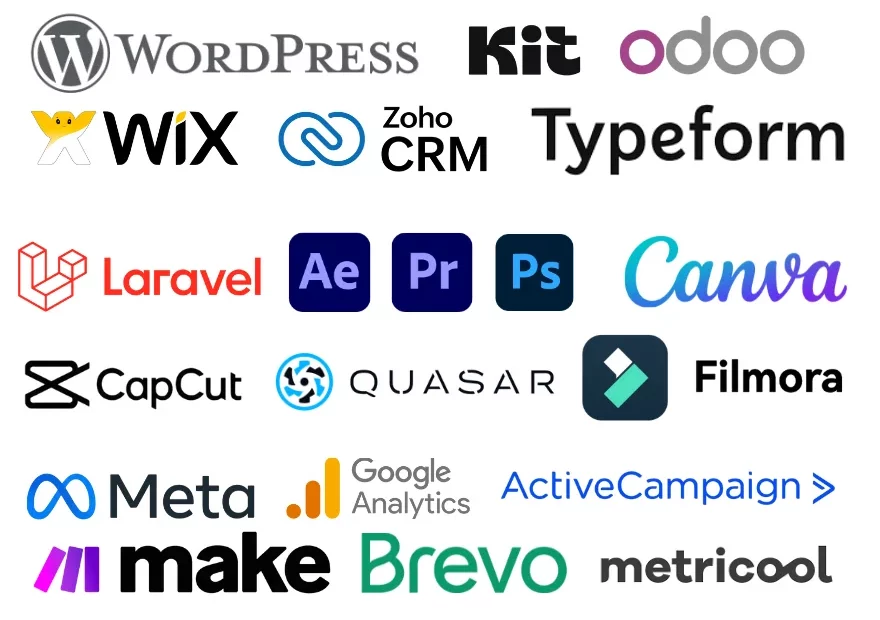
We build success using the best tools.

Choose your ideal plan
Clarifying your concerns: Quick answers for you.
What type of systems can you integrate?
We can integrate a wide variety of business systems, including CRMs (Salesforce, HubSpot, Zoho CRM), ERPs (SAP, Oracle, Odoo), e-commerce platforms (Shopify, WooCommerce, Magento), marketing automation tools (Kit, Brevo, ActiveCampaign), accounting systems (Zoho, Odoo), custom databases, and almost any other application that offers an API or allows data export/import.
How long does it take to implement a systems integration?
Implementation time varies considerably depending on the complexity of the systems, the volume of data to synchronize, the availability of APIs, and the complexity of the desired workflows. A simple integration between two standard apps could take a few weeks, while a complex ecosystem with multiple custom systems may require several months.
What happens to my data security during integration?
Throughout the integration process, robust security protocols are implemented, including data encryption in transit and at rest, secure authentication for API access, and compliance with security best practices to protect your sensitive information. Integrations are designed to minimize data exposure and strictly control access.
Do I need to replace my current systems to integrate them?
No, our main goal is precisely to avoid you having to replace your existing and expensive systems. Integration aims to make your current systems work together more efficiently. Only in very specific cases where a system is extremely obsolete or incompatible might modernization be recommended, but integration is the first solution to consider.
What level of maintenance do integrations require once implemented?
Once implemented, integrations require continuous maintenance and monitoring to ensure stability. This includes supervising data flows, managing errors, applying updates when integrated systems change their APIs, and optimizing performance.